MANAGED SEO
GET FOUND ON GOOGLE WE DO THE WORK
We build your website for a one-time $99.
Managed is $79.90 a month: the software licence, hosting,
hands-on support, and the SEO work on your site every month,
so the customers searching for what you do find you.
Managed is $79.90 a month: the software licence, hosting,
hands-on support, and the SEO work on your site every month,
so the customers searching for what you do find you.
EVERY MONTH
WHAT WE WORK ON
We find the searches your customers actually type, the ones that end in a booking or a call, and decide which pages should win them. Then we write and tune those pages: the words, the titles, the structure, so Google knows exactly what you offer and where.
Every page of your site gets a live score against the search it targets, and we keep working it toward 100. The technical side runs underneath: how the site is built, how fast it loads, what it tells Google. It happens without you, month after month.
REAL RESULTS
FIRST PAGE WITHIN MONTHS
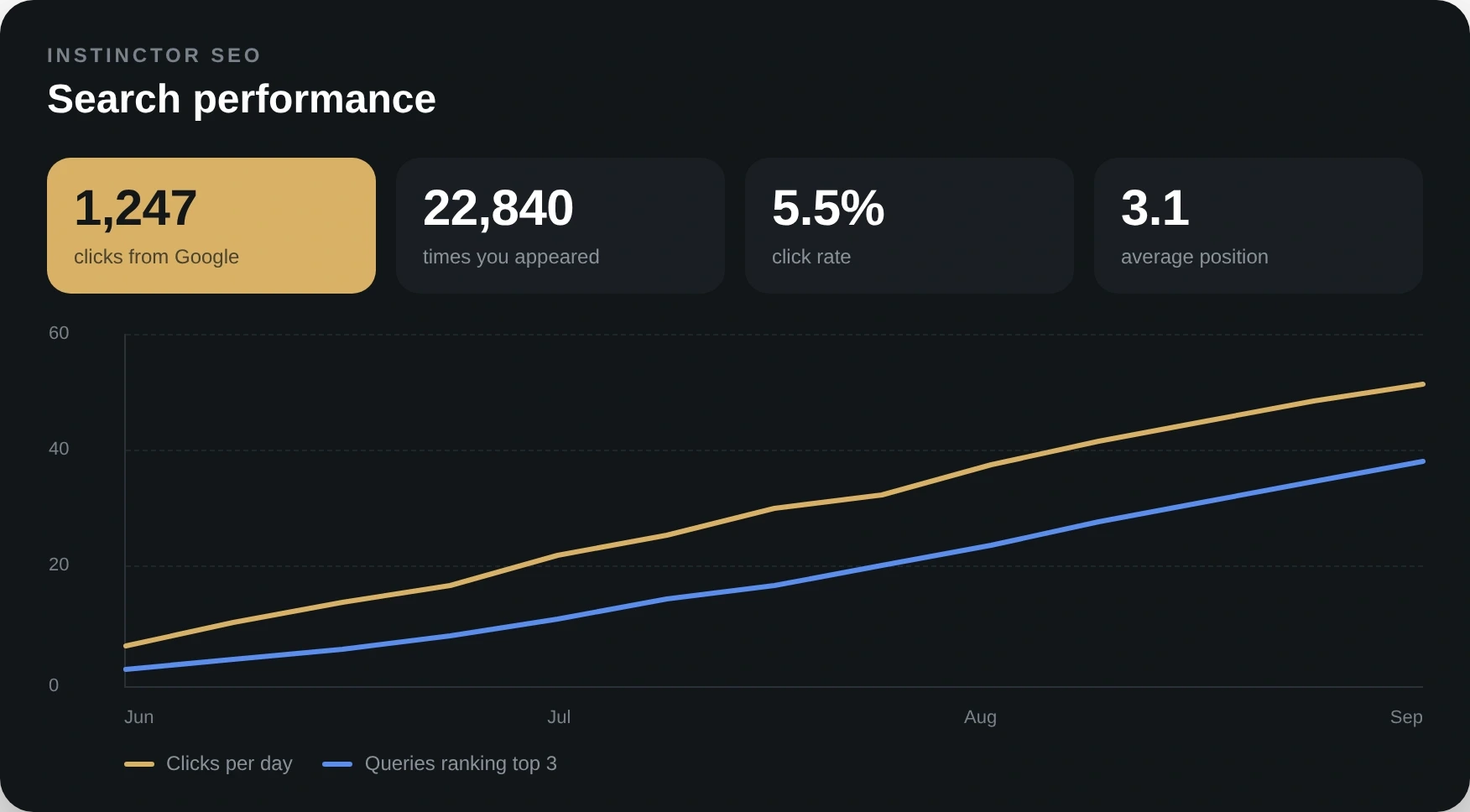
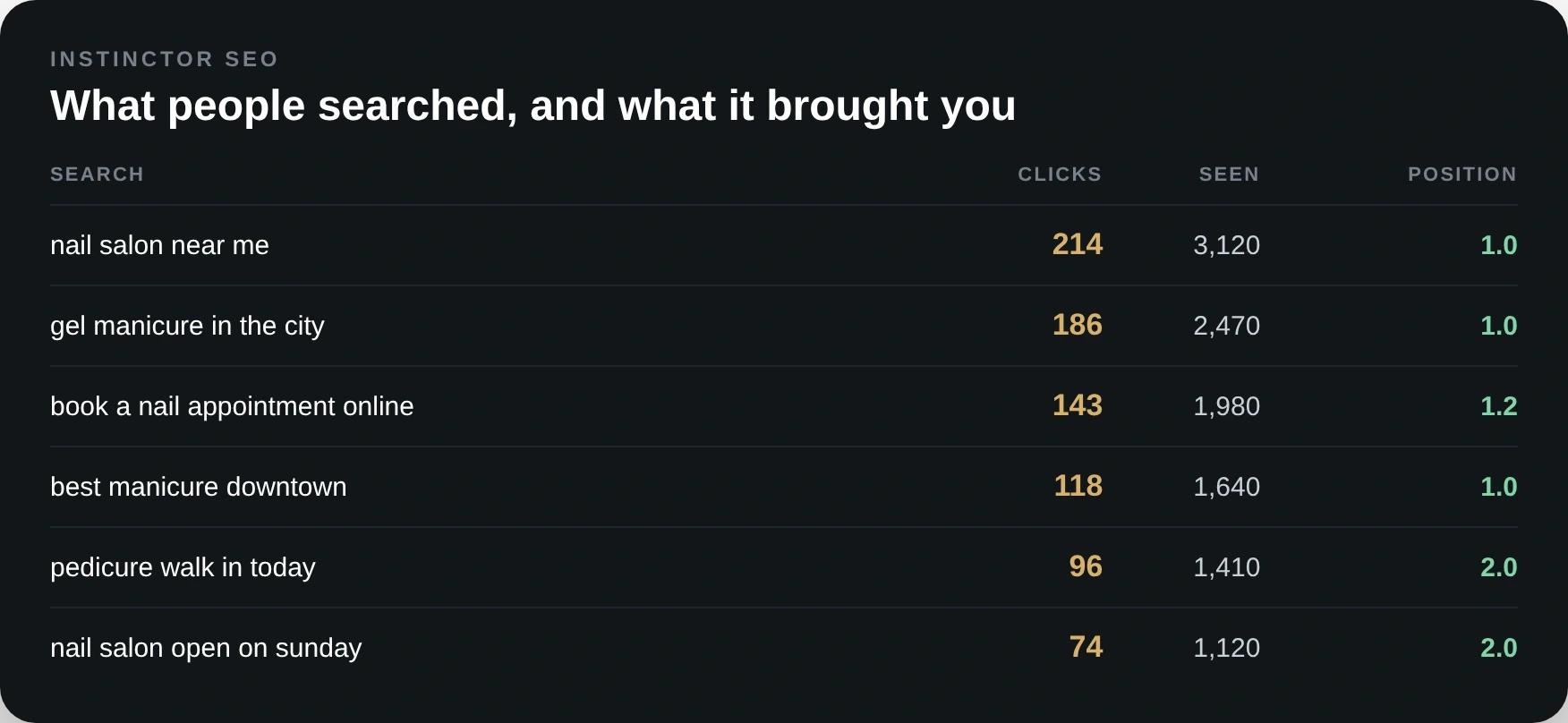
Joyavend, a vending company in Los Angeles, holds the top position for its main local searches. American Olympic Karate, Philly Assembly and Sun and Soap reached Google's first page too, all within months. These are Joyavend's real numbers from the last 28 days.
AGENCIES AND FREELANCERS
WHY SWITCH
An SEO freelancer or agency usually bills by the month or by the hour, works from outside your site, and hands you a report.
We work inside it, every month, at one flat price.
We work inside it, every month, at one flat price.
InstinctorTypical agency
- Monthly price$79.90Often hundreds
- Works your site every monthYesVaries
- Works inside your siteYesFrom the outside
- Live score on every pageYesRarely
ONE PRICE $79.90 A MONTH
Managed is $79.90 a month and the SEO work is part of it, never a separate bill.
If you do not have a site yet, the website is a one-time $99, and the chat in the bottom right will tell you what yours includes.
If you do not have a site yet, the website is a one-time $99, and the chat in the bottom right will tell you what yours includes.
WHAT IT FIXES
YOUR CUSTOMERS ARE ALREADY SEARCHING
The first page without you. Someone nearby searches for exactly what you do, and three other businesses show up. We work the searches you should own until you are one of them.
The one-time setup. Most sites get an SEO pass at launch and never again. Rankings move every month, so we work your site every month.
The work nobody sees. Page titles, structure and the details Google reads. You never have to learn any of it, or pay someone by the hour to explain it.
This is the work Managed covers, every month, on your site.
Tap or hover any item to see what it does.
Tap or hover any item to see what it does.
- Picking the searches
- One search per pageEach page is given the one search it is meant to answer. Everything else on that page is then judged against it.
- Searches where you nearly rankSearches where you already show up around positions eight to twenty, with people looking. These are the pages worth working next.
- The searches you already get seen forYour top queries, pulled from Google Search Console. The words customers use are rarely the words a business uses about itself.
- Two of your pages competing for one searchWe check whether two of your pages are set to the same search. When they are, they split the attention and we give one of them a different job.
- Results read over a week, a month and three monthsThe same searches read over three windows, so a quiet week is not mistaken for a trend.
- Working each page toward 100
- A score and a grade for every pageEach page is scored out of 100 against the search it targets, with a letter grade. We keep working it upward.
- Page titles the length Google will showGoogle cuts a title that runs long and ignores one that is barely there. Yours is written to fit the space it gets.
- Descriptions that fit the results pageThe two lines under your title in the results. They decide whether someone clicks you or the next listing.
- The search term in the title, description and addressWe check the page title, the description and the web address all carry the words the page is meant to win.
- Pages flagged when they are too thinThin pages get counted and flagged. A page with almost nothing on it has little chance against one that answers the question.
- Links between your own pagesPages with no link pointing to them are easy to miss, for a visitor and for Google. We connect the related ones.
- What Google reads
- The title that appears in resultsWritten per page and built to a pattern, so every page carries your business name without repeating itself.
- The description under itWritten per page. Where one is missing, your business description fills the gap rather than leaving it blank.
- One address per pageA canonical address tells Google which version of a page is the one to list, so two addresses for the same content do not compete.
- Pages kept out of results on purposeDrafts, thank you pages and working material are marked so they stay out of search. The pages that sell stay in.
- Your business details as dataName, address, hours, services and breadcrumbs are published in the format Google reads directly, alongside the page people read.
- How your link looks when sharedTitle, text and image for the preview card on Facebook, LinkedIn, WhatsApp and X. Without them a shared link shows a bare address.
- Getting crawled and keeping the addresses
- A sitemap that stays currentA machine readable list of your pages and products, rebuilt as the site changes, so nothing waits to be stumbled on.
- Instructions for search engine crawlersThe file that tells crawlers what to read and what to skip, with room for rules specific to your site.
- Search engines told when a page changesPublishing or editing a page sends a notice to the engines that accept one, including every language version of it.
- Old addresses pointed at new onesWhen a page moves or is renamed, the old address forwards. We can see how often each forward is used, which shows what people still look for.
- Removed pages reported as gone, not missingA removed page with no replacement is reported as gone rather than quietly forwarded, which is what gets it dropped cleanly.
- A dead address still sends the visitor somewhereA visitor who reaches an address that no longer exists is sent to your home page or to a page you choose.
- Speed and images
- Measured on a phone and on a desktopYour pages are tested on Google's own service, separately for each, because most people arrive on a phone.
- Speed as real visitors actually experienced itWhere a page has enough traffic, Google reports the speed real Chrome users saw over the last four weeks, next to the lab test.
- The slowest things on each page, rankedThe specific items costing the most time on that page, sorted, so the work goes where it changes the number.
- Images cut down to sizePhotographs are compressed and resized for the web. Oversized images are the usual reason a good looking page loads slowly.
- Every image describedAlt text says what a picture shows. It is what Google reads instead of the image, and what a screen reader says out loud.
- Seeing what happens
- Clicks and impressions from GoogleHow often you were shown and how often you were picked, in your dashboard, from Search Console.
- Which of your pages Google showsYour pages ranked by how much search they bring in. It is often not the page you expect.
- Visitors, time on page, bounceWhat people did once they arrived. A search that brings people who leave at once is telling you something about the page.
- Where they came fromSearch, social, directories, links from other sites and direct visits, separated, so search is not credited with all of it.
- Which sources turn into enquiriesCalls, messages and form submissions traced back to the channel and the page that produced them.
- Your own visits excluded from the countsYour visits and known crawlers are excluded from the counts, so the numbers describe customers rather than you checking the site.
Ask anything
